2026 Q1 GEO Case Study: Which Laptop Brands Win in China's AI Search — and Why
This study investigates laptop brand visibility across Baidu AI, DeepSeek, and Doubao. It finds that Lenovo and ASUS dominate visibility, while other brands perform variably. Platforms rely on different sources, such as Toutiao for Doubao and tech media for DeepSeek. The research highlights that GEO strategies must focus on content structure, source distribution, and aligning with user intent to improve visibility and ranking.
Introduction
As AI platforms become a common entry point for product research, the way brands are recommended is starting to change. Users are no longer browsing lists of search results. Instead, they receive synthesized answers that already include brand suggestions.
This raises a practical question for marketers. When a user asks an AI platform which laptop to buy, which brands actually appear, and why?
This study looks at brand visibility across three major AI platforms in China: Baidu AI, DeepSeek, and Doubao. The goal is not to rank brands in a traditional sense, but to understand how visibility is formed inside AI-generated answers.
Methodology
Platforms
The analysis covers three platforms:
Baidu AI
DeepSeek
Doubao
These platforms differ in both model behavior and content sourcing strategy, which makes comparison meaningful.
Prompt Design
Instead of using keywords, the study is based on structured user questions.
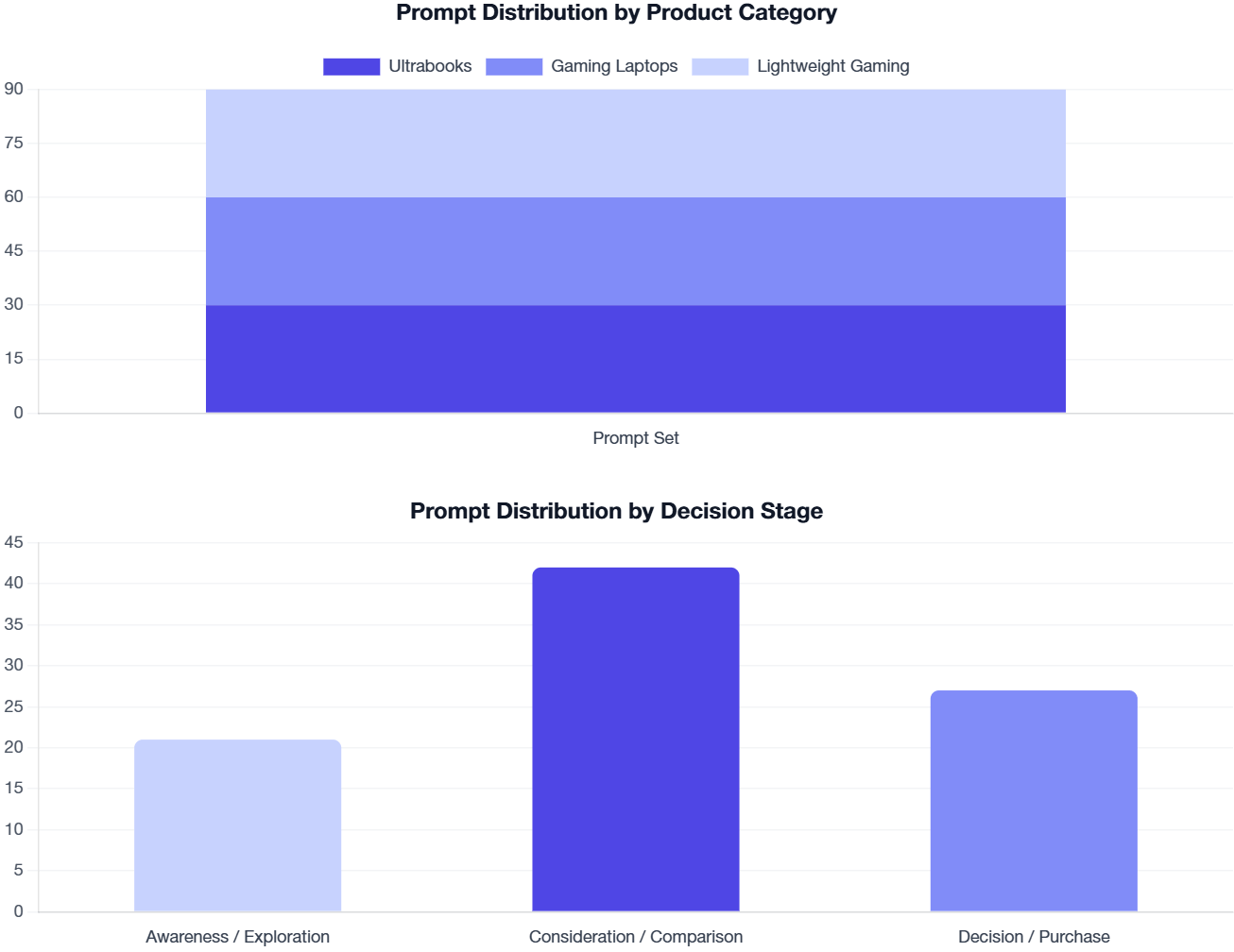
Prompts were designed across five dimensions:
Product category: ultrabook, gaming laptop, lightweight gaming
Use case: office work, development, study, entertainment, design
Budget: entry-level, mid-range, high-end
Core needs: performance, thermals, design, value, build quality
Decision stage: awareness, consideration, decision
Product categories were evenly balanced by design, while decision stages were distributed more naturally to cover a wider range of real-world comparison and purchase scenarios.
This structure allows the dataset to reflect real user intent across different stages, rather than isolated queries.
Example Prompts
经常需要带笔记本开会,外观要时尚、轻薄,2026年新品里哪个牌子比较合适?(I often need to carry my laptop to meetings. It should be lightweight and have a stylish design. Which brands offer good options among the 2026 new releases?)
学生党,想买个能玩主流游戏的笔记本,散热不能差,2026年性价比高的品牌有哪些?(I'm a student looking for a laptop that can handle mainstream games. It needs decent thermals, and I'm looking for good value for money in 2026. Which brands should I consider?)
程序员,需要开发用笔记本,配置高、散热好,偏好轻薄游戏本,2025-2026年有什么推荐的一线品牌?(I'm a developer looking for a high-performance laptop with strong specs and good thermal performance. I prefer lightweight gaming laptops. Which top-tier brands are worth considering for 2025–2026?)
Dataset and Metrics
The dataset includes around 90 prompts, evenly distributed across categories.
For each AI response, the following metrics were extracted:
Brand visibility: percentage of answers where a brand appears
Average ranking: average position within the answer
Source references: domains cited in the response
Overall Brand Visibility
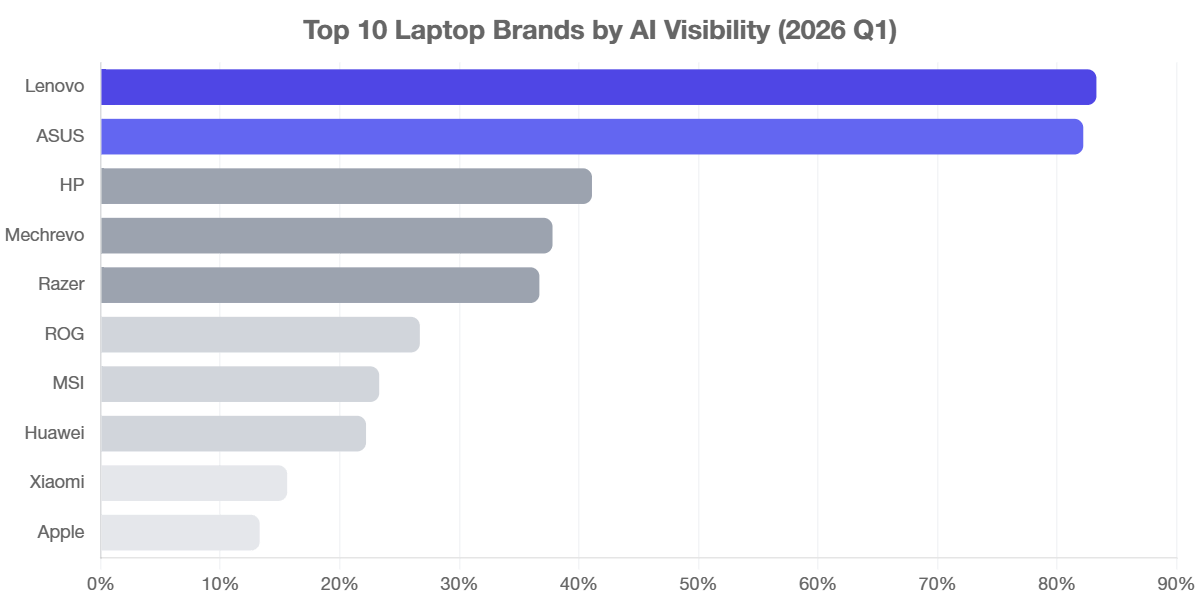
Across all platforms, visibility is concentrated among a small number of brands.
Key observations:
Lenovo and ASUS dominate, both above 80 percent visibility
HP, Mechrevo, and Razer form a second tier
Most other brands appear in less than 30 percent of answers
This suggests that AI-generated recommendations tend to converge around a limited set of brands, rather than reflecting the full market.
Differences Across Platforms
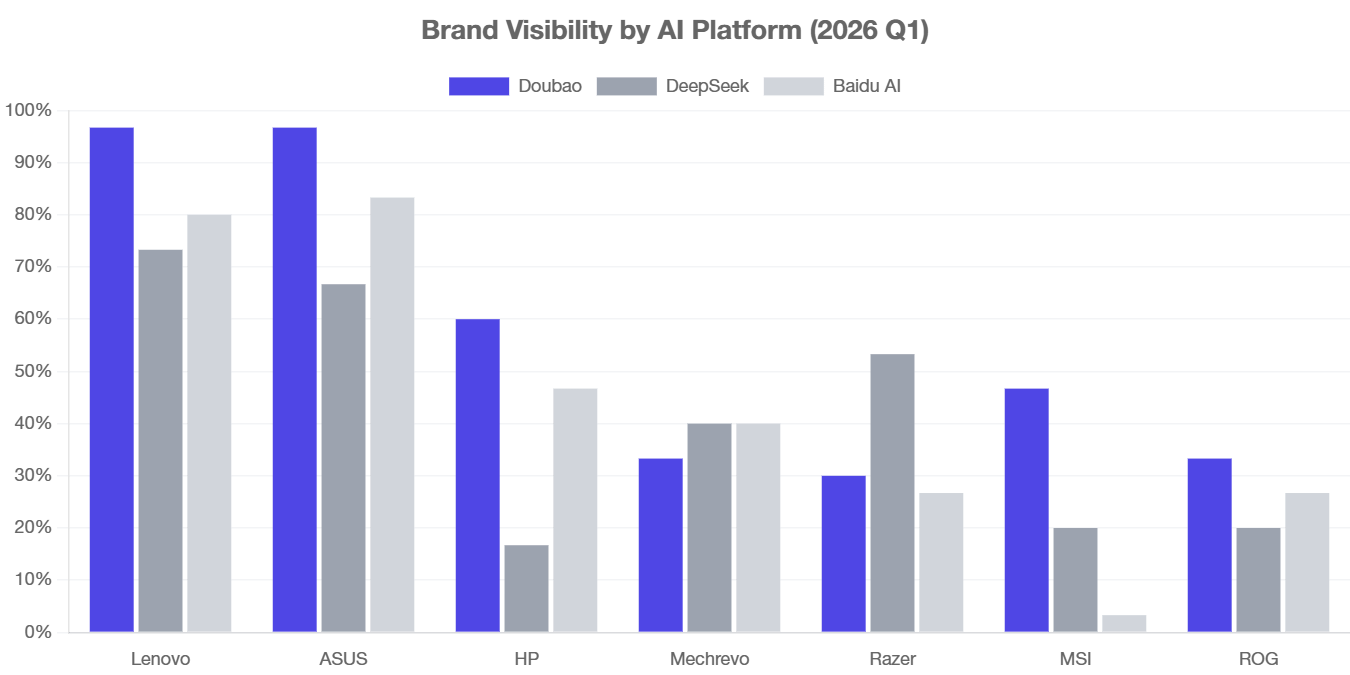
Brand visibility varies significantly between platforms.
Some clear patterns:
Doubao shows extremely high concentration, with Lenovo and ASUS appearing in almost all answers
Baidu AI presents a more balanced mix but still favors major brands
DeepSeek includes more niche and enthusiast-oriented brands
These differences are not random. They reflect how each platform selects and prioritizes its source content.
Visibility and Ranking Are Not the Same
A brand appearing frequently does not always mean it ranks highly within answers.
For example:
Some brands have low overall visibility but strong average ranking
Others appear often but are listed lower in recommendations
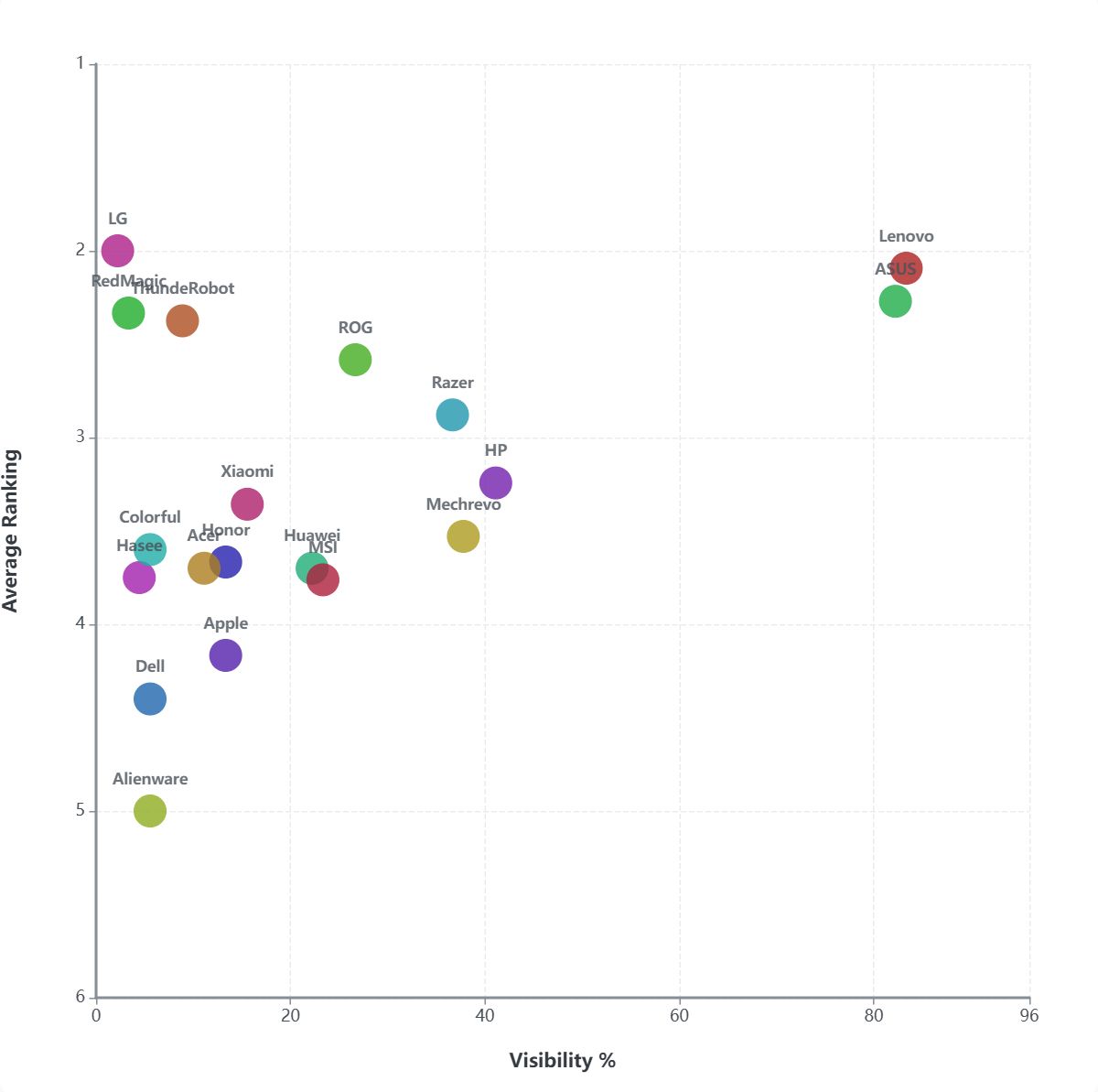
This distinction matters in practice. Being included in answers increases exposure, but top positions influence user decisions more directly.
Category-Level Differences
Brand performance also changes depending on product category.
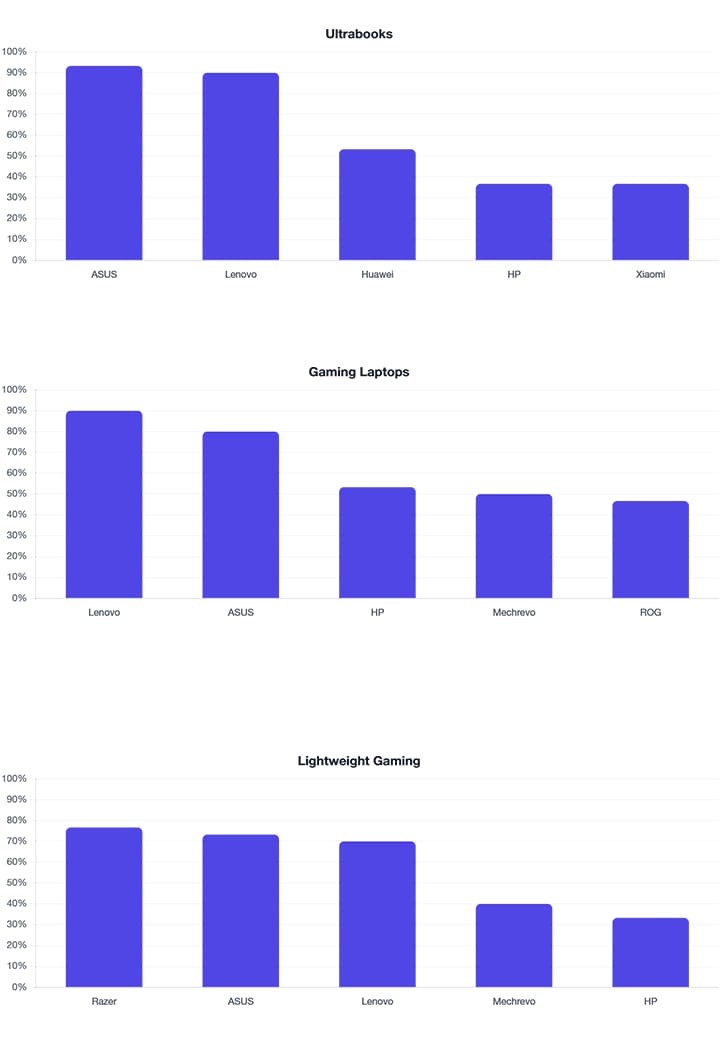
Examples:
In ultrabooks, ASUS, Lenovo, and Huawei appear most frequently
In gaming laptops, Lenovo, ASUS, and ROG lead
In lightweight gaming laptops, Razer becomes much more prominent
This shows that visibility is not a single metric. It is tied to specific use cases and intent clusters.
In other words, a brand may appear strong overall, but still be absent in the exact scenarios where users are making decisions.
Source Analysis: Why These Brands Appear
One of the more important parts of the study is source analysis.
AI platforms do not generate recommendations purely from internal knowledge. They rely on external content and cite it in their answers.
Platform Differences in Sources
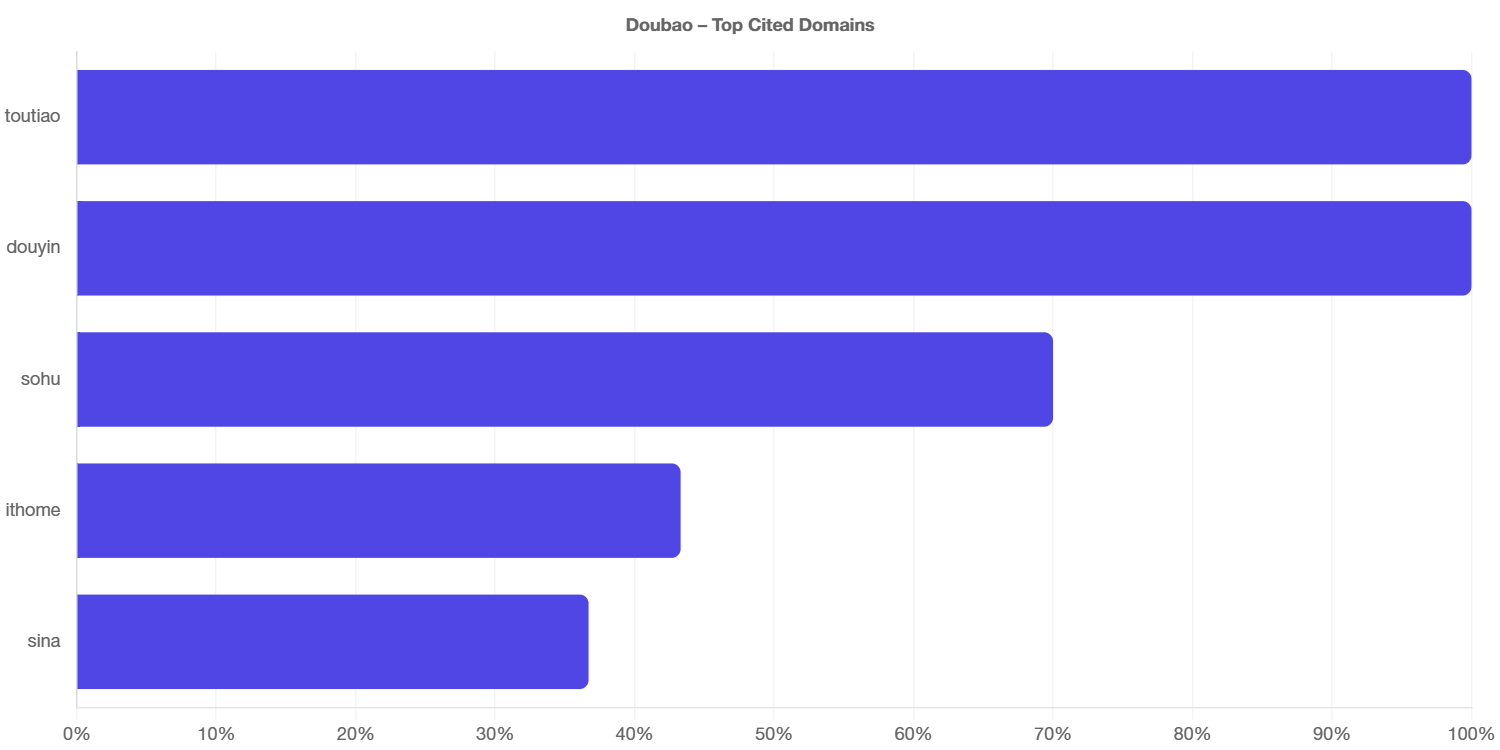
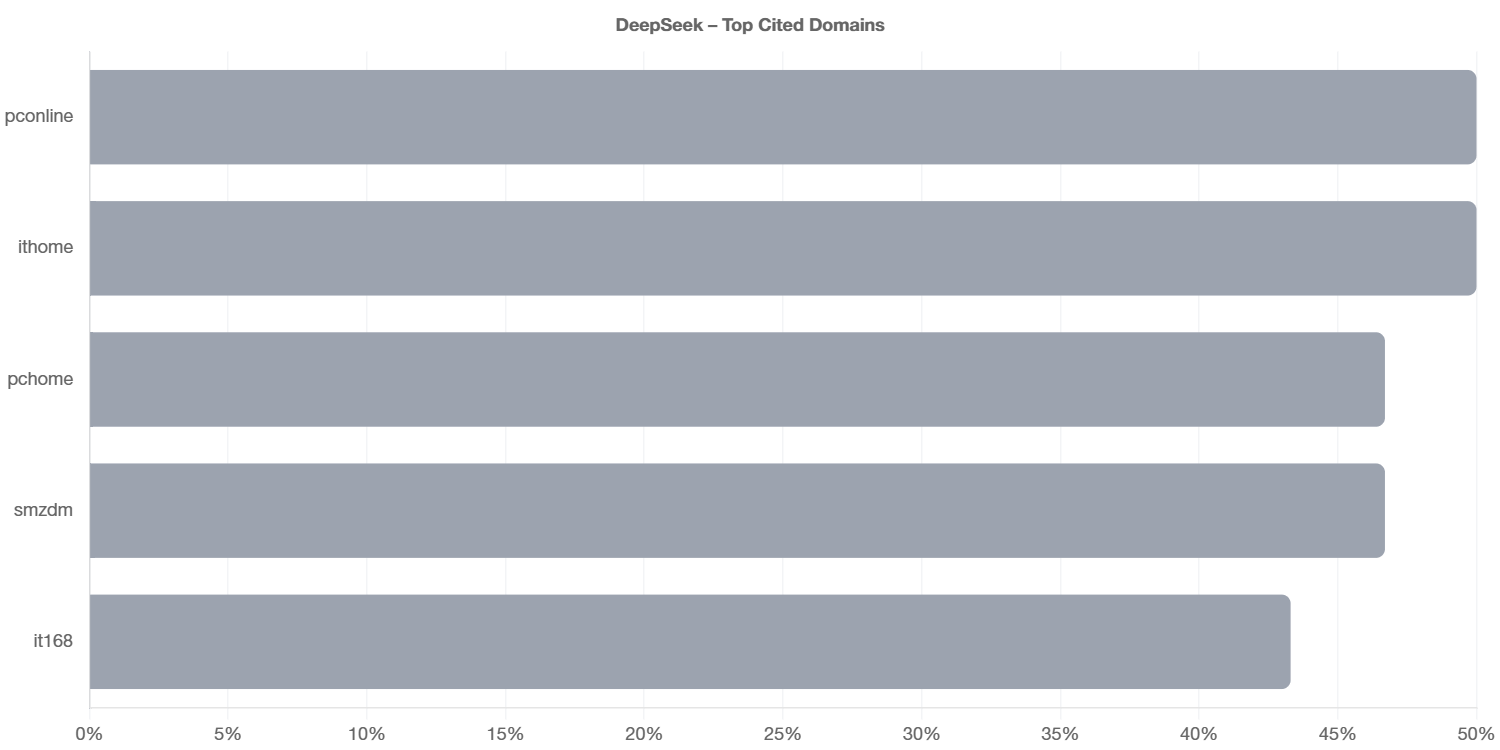
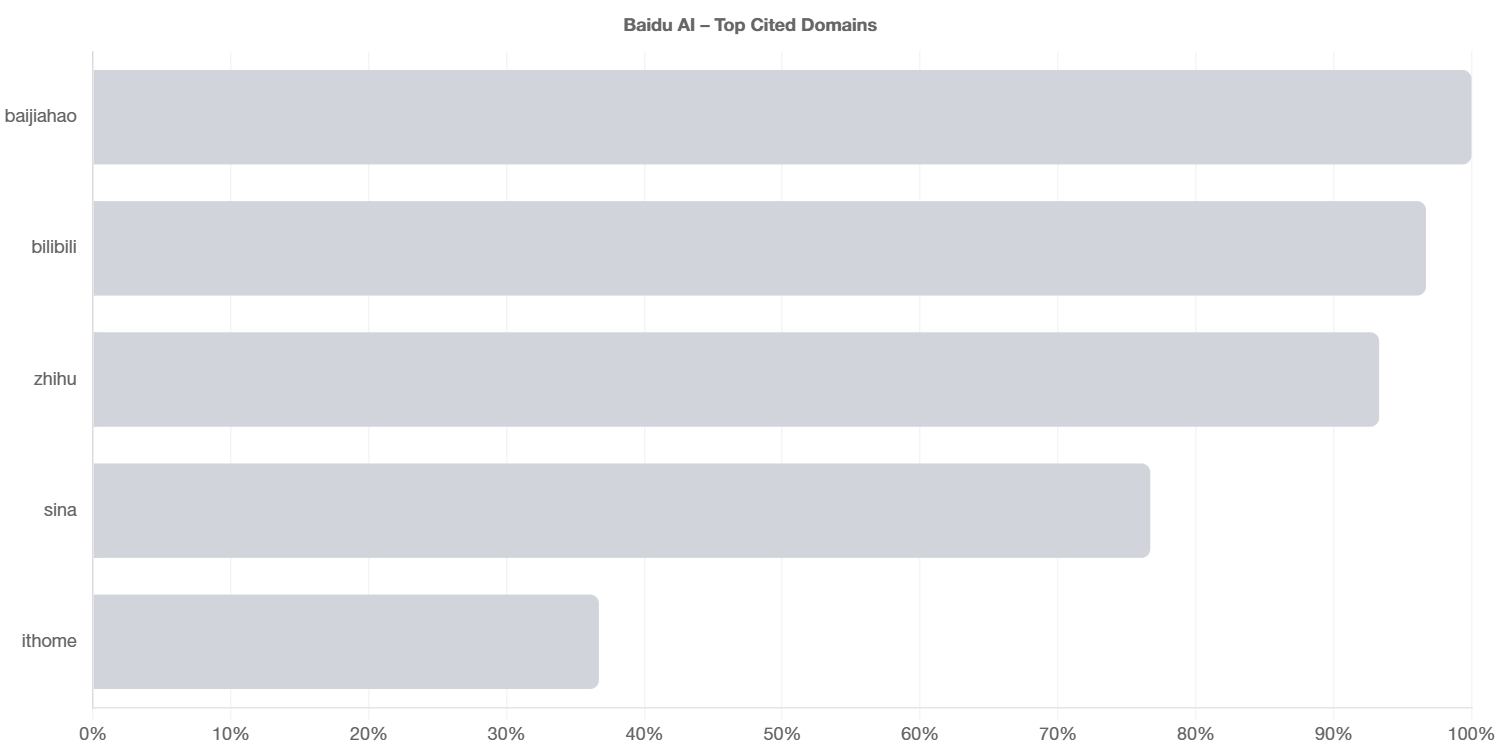
Observed patterns:
Doubao relies heavily on Toutiao and Douyin-related content
Baidu AI favors Baijiahao, Zhihu, and Bilibili
DeepSeek draws more from tech media and vertical content sites
These differences explain why brand visibility varies across platforms.
Source Concentration Matters
However, it is not just about which sources are used, but how concentrated they are.
Some platforms rely heavily on a small number of dominant domains, while others distribute citations more evenly.
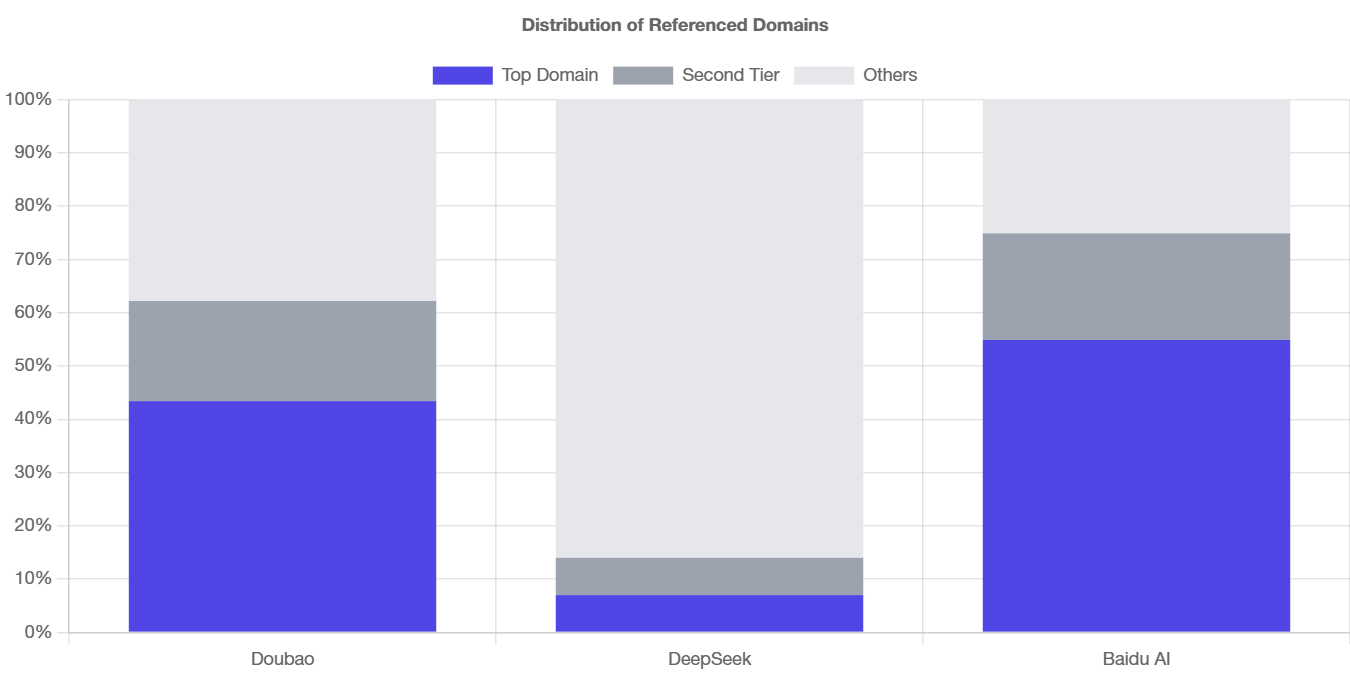
This has direct implications for GEO strategy:
On platforms like Doubao and Baidu AI, dominating a few key domains can significantly impact visibility
On platforms like DeepSeek, broader coverage across multiple sites becomes more important
What the Data Suggests About Content Strategy
Looking beyond brand rankings, the data also reveals patterns in how content influences AI answers.
Content Placement Matters
Publishing in the right platforms is important, but it is only part of the picture.
The most frequently cited sources are not just well distributed. Their content is also structured in a way that is easy for AI systems to extract and reuse. This includes clear comparisons, specific use cases, and explicit brand mentions.
Content Structure and Topics Matter
By reviewing highly cited pages, it becomes clear that certain content patterns are more likely to be picked up:
Direct comparisons between brands
Scenario-based recommendations
Clear summaries of strengths and weaknesses
This means content design plays a direct role in whether it becomes part of AI-generated answers.
GEO Is Closely Connected to Content Marketing
Brands with stronger visibility tend to have content that is:
Distributed across multiple platforms
Consistent in messaging
Referenced across different sources
This creates a form of cross-source validation, which increases the likelihood of being selected by AI systems.
Prompt Coverage Defines Visibility Limits
Visibility is also constrained by how many relevant query scenarios a brand is associated with.
If a brand only appears in a narrow set of topics, it will not scale across broader AI queries. Expanding coverage requires aligning content with a wider range of user intents.
Implications for GEO
From this case, several practical implications emerge:
GEO is not just about ranking content, but about being selected as a source
Different platforms require different content distribution strategies
Content placement and content structure are equally important
Visibility is built through alignment between user queries, content topics, and platform ecosystems
Conclusion
AI platforms are becoming a new layer of content distribution. They do not simply reflect existing information. They filter, combine, and prioritize it.
As a result, brand visibility is no longer only determined by search rankings. It is shaped by how content is created, where it is published, and how it is reused by AI systems.
Understanding these mechanisms is the first step toward building a sustainable GEO strategy.
Closing Note
This analysis is part of an ongoing effort to make AI search visibility more measurable and actionable.
I am currently building a system to support this kind of analysis at scale, including deeper insights into source patterns, topic clustering, and brand positioning within AI-generated answers.