China Pharmaceutical AI Search Landscape 2026: What 125,000 AI Responses Reveal
In Q2 2026, Sinohealth MedCortex analyzed approximately 125,000 health-related queries across five major Chinese AI platforms and five leading pharmaceutical categories. The study found that retail market leadership does not automatically translate into AI visibility, AI typically organizes medication within broader healthcare decision pathways, and 95.0% of responses reached a drug-selection direction while only 29.1% reached a commercial brand. This article examines what these findings mean for pharmaceutical GEO, healthcare ontology, and the shift from content visibility to structured pharmaceutical knowledge governance.
In Q2 2026, our team at Sinohealth studied how major Chinese AI platforms respond to pharmaceutical and health-related questions.
The study covered five leading pharmaceutical categories in China's 2025 retail market, five major AI platforms (Doubao, Qwen, DeepSeek, ERNIE and Tencent Yuanbao) and approximately 125,000 health-related queries. The questions focused on natural, non-brand-directed needs at the top of the consumer decision funnel.
The work eventually became the China Pharmaceutical AI Search Landscape Insights White Paper 2026 Q2.
One finding shaped how I now think about pharmaceutical AI search:
AI visibility is the output of a much longer decision process.
Before a drug or brand appears, the AI has already interpreted the user's health state, assessed possible risks, selected a course of action and connected that action to pharmaceutical knowledge.
That makes pharmaceutical AI search a useful window into how AI is beginning to structure healthcare knowledge.
This article covers only part of what we found. The full China Pharmaceutical AI Search Landscape Insights White Paper 2026 Q2 includes the complete research framework, data findings and analysis across five pharmaceutical categories and five major Chinese AI platforms. |
The real competition starts before the drug name appears
Most brand-level GEO analysis starts with straightforward metrics:
brand mentions;
share of voice;
recommendation position;
competitor ranking.
These are useful outcome metrics. They tell us little about how the product reached that position.
A real consumer may ask:
"I keep coughing more at night. What should I do?"
"My elderly parent has knee pain when walking."
"My child has had a poor appetite recently. Should I give them something?"
At this stage, the AI has to determine what the problem could be and what type of action is appropriate.
The possible paths include medication, self-care, nutrition, assessment, professional consultation and other interventions.
A pharmaceutical product therefore enters the answer only after several upstream decisions have already been made. This is why our research focused on top-of-funnel health needs, where consumers describe symptoms, situations and concerns without naming a product.
We used context, not a fixed keyword list
Healthcare decisions depend heavily on context.
Age, symptom duration, severity, previous treatment, comorbidities, pregnancy, care roles and real-life constraints can all change the appropriate next step.
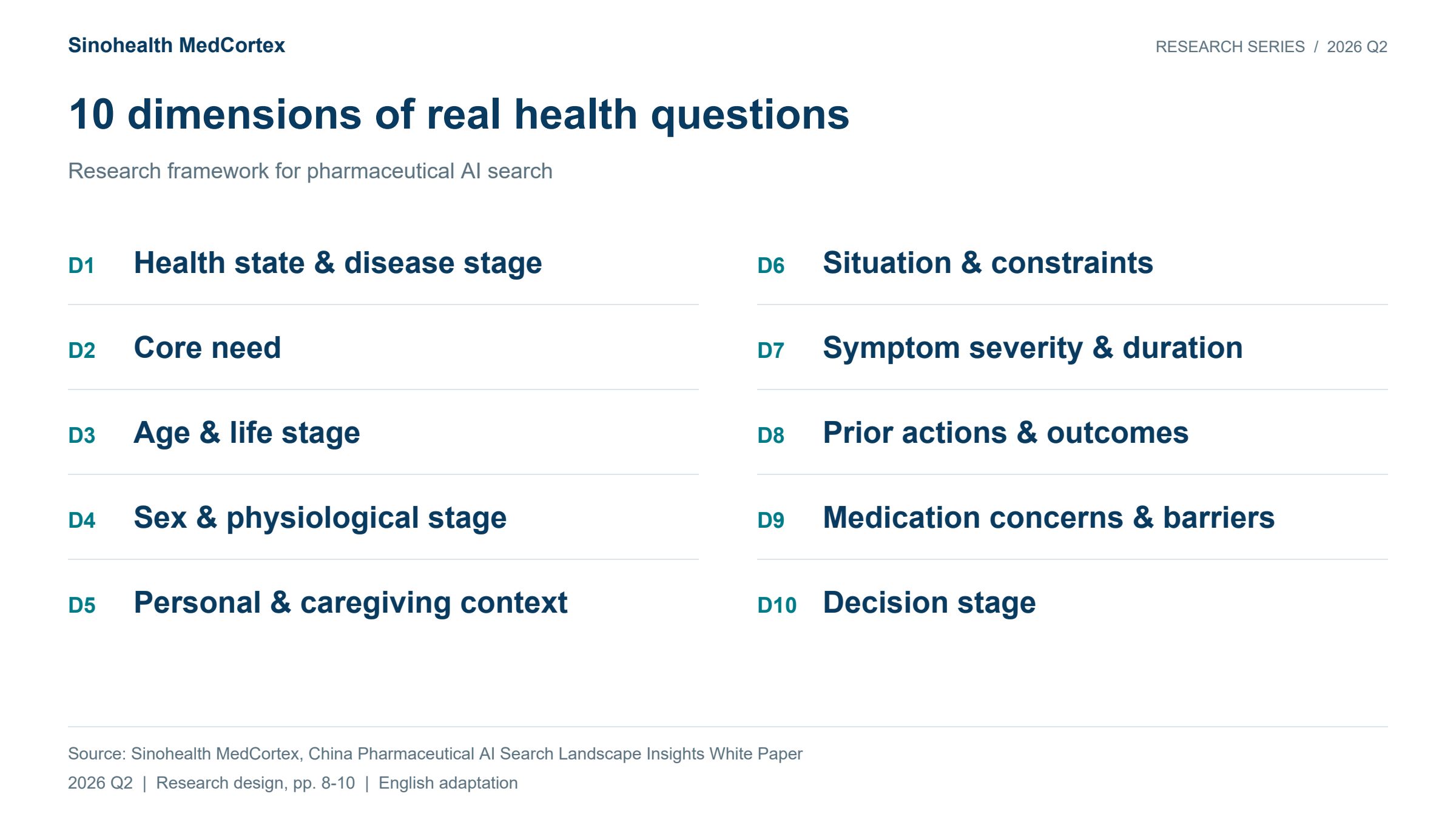
We therefore built a ten-dimensional semantic framework around three questions:
Who is asking?
What health state are they in?
What could change the decision?
The framework varied disease stage, core need, age and life stage, care background, scenario, symptom severity, previous actions, treatment concerns and decision stage.
This matters because AI needs to translate everyday language into medically meaningful conditions.
A statement such as "My elderly parent's knee hurts when walking" contains several possible knowledge objects and relationships:
person → symptom → severity → functional impact → possible causes → risk → action → treatment
That chain is much closer to the structure of a real healthcare decision than a keyword-to-brand relationship.
Market leadership does not automatically transfer into AI answers
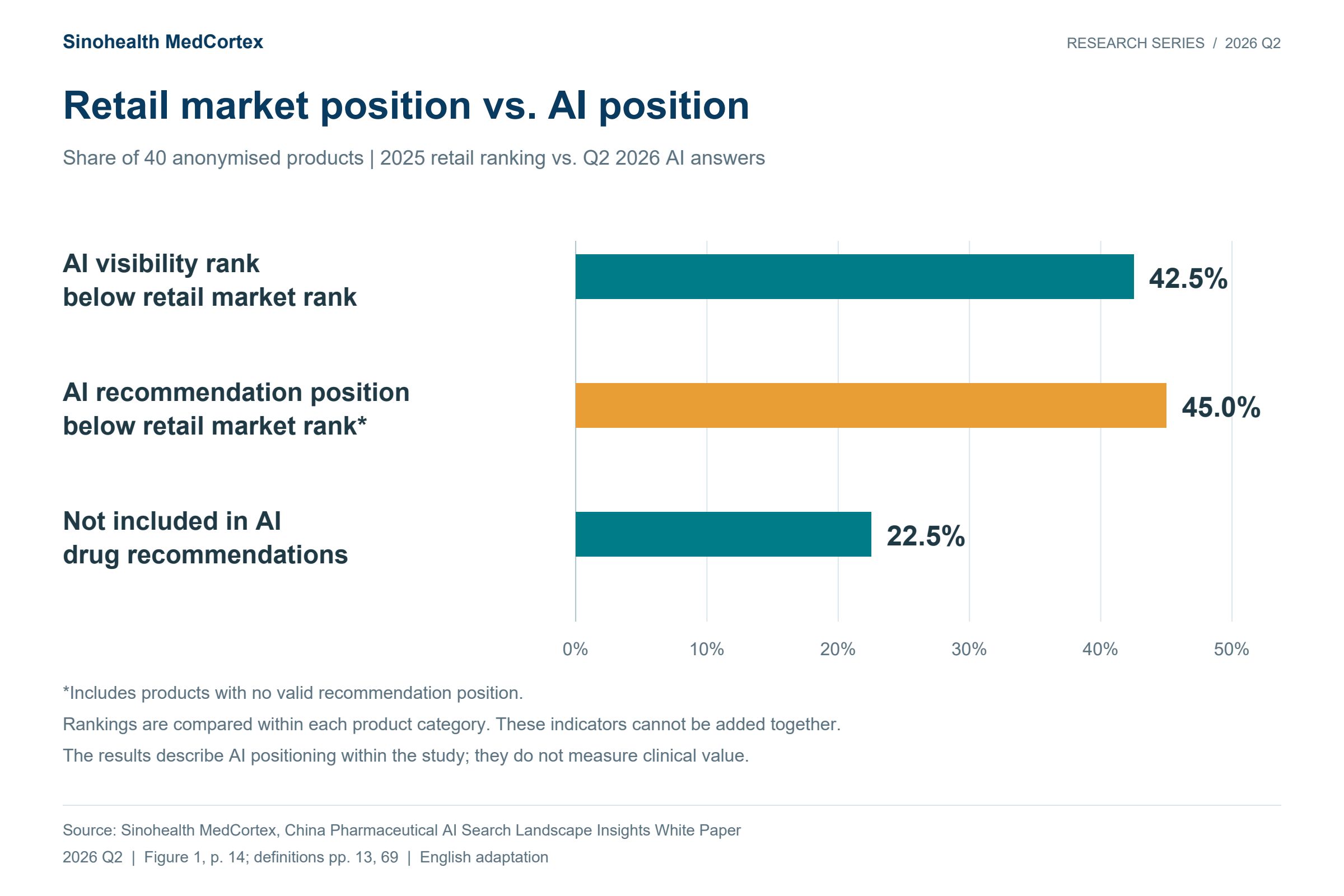
We compared the 2025 retail market positions of 40 anonymised pharmaceutical products with their performance in AI-generated answers.
The results were striking:
42.5% ranked lower in AI visibility than in retail market share;
45.0% ranked lower in AI recommendation position;
22.5% did not enter the AI-generated drug recommendations within the scope of the study.
The result makes sense once we look at the decision chain.
Transition 1: Health need → pharmaceutical pathway
The AI first decides whether medication is appropriate at all.
Some questions should lead to professional consultation, further assessment, rehabilitation or observation.
Transition 2: Everyday language → professional judgement
Consumer language has to be translated into relevant clinical conditions: symptoms, duration, severity, population, previous treatment and risk factors.
Transition 3: Pharmaceutical knowledge → brand
The AI then needs to connect drug class → ingredient → generic medicine → commercial brand, while preserving indications, population constraints and safety boundaries.
A visibility gap can emerge at any of these stages.
So the useful diagnostic question becomes:
Where did the product lose relevance in the decision pathway?
That question gives a pharmaceutical company something it can actually investigate.
AI is structuring a course of action
Another important finding came from analysing how AI organised possible solutions.
Medication appeared in 91.6% of responses and served as a core solution pathway in 87.3%.
Other paths were also common:
professional consultation: 83.0% appearance rate;
lifestyle and self-care: 71.5%;
diet and nutrition: 49.3%;
tests and assessments: 24.4%;
non-pharmaceutical treatment and rehabilitation: 19.2%.
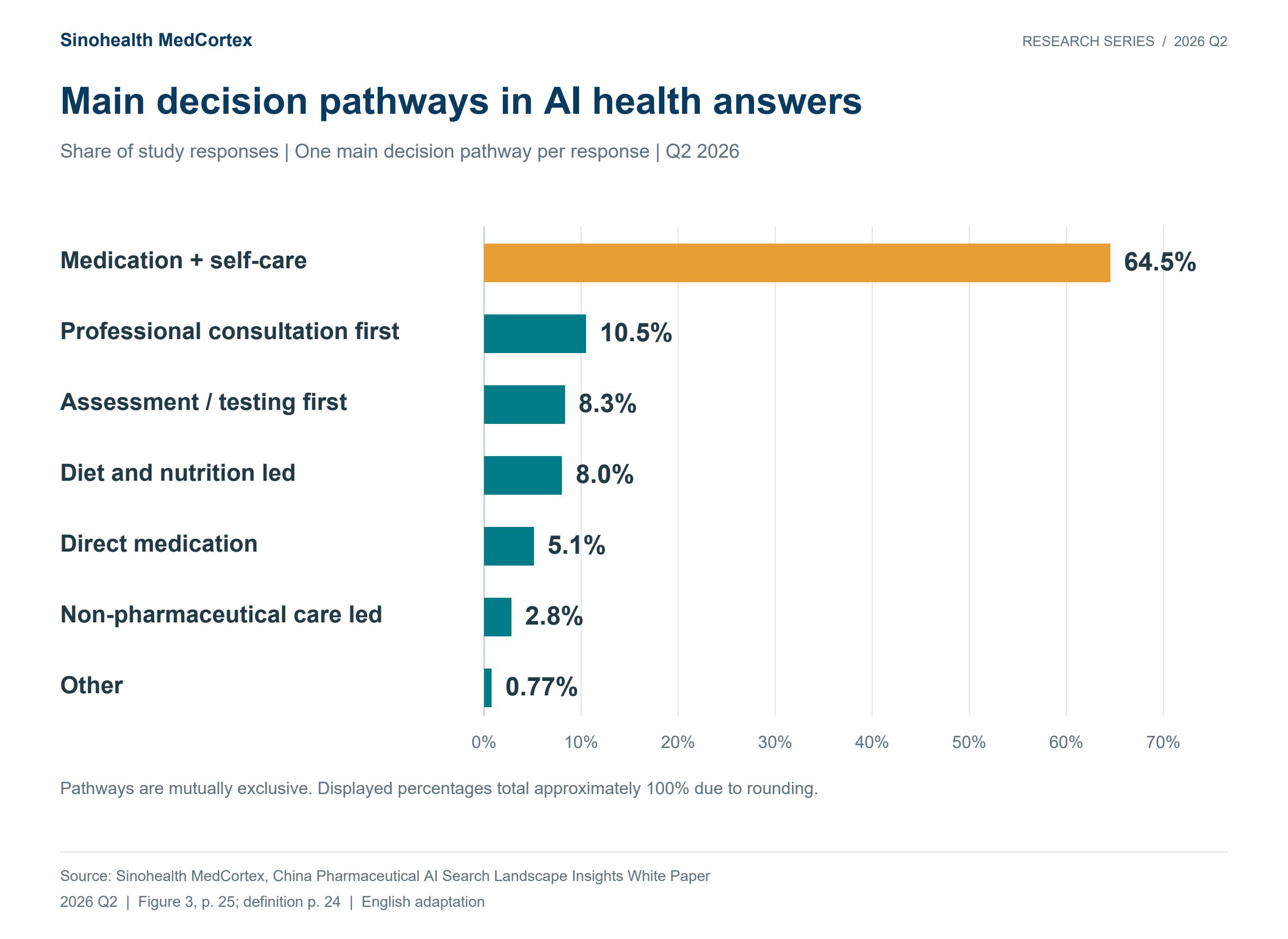
The main decision structure is even more revealing.
Medication + self-care accounted for 64.5% of responses. Direct medication alone accounted for only 5.1%.
This changes how product visibility should be interpreted.
A drug can play very different roles inside an answer:
primary intervention;
one option among several;
conditional treatment;
treatment after risk exclusion;
short-term action before reassessment.
The surrounding conditions matter as much as the mention itself.
A typical AI decision structure may look like:
symptom → initial treatment → self-care → observation → warning signs → professional escalation
The product occupies one node in that structure.
AI often reaches the medicine before it reaches the brand
The distinction becomes even clearer at the naming level.
Across the study:
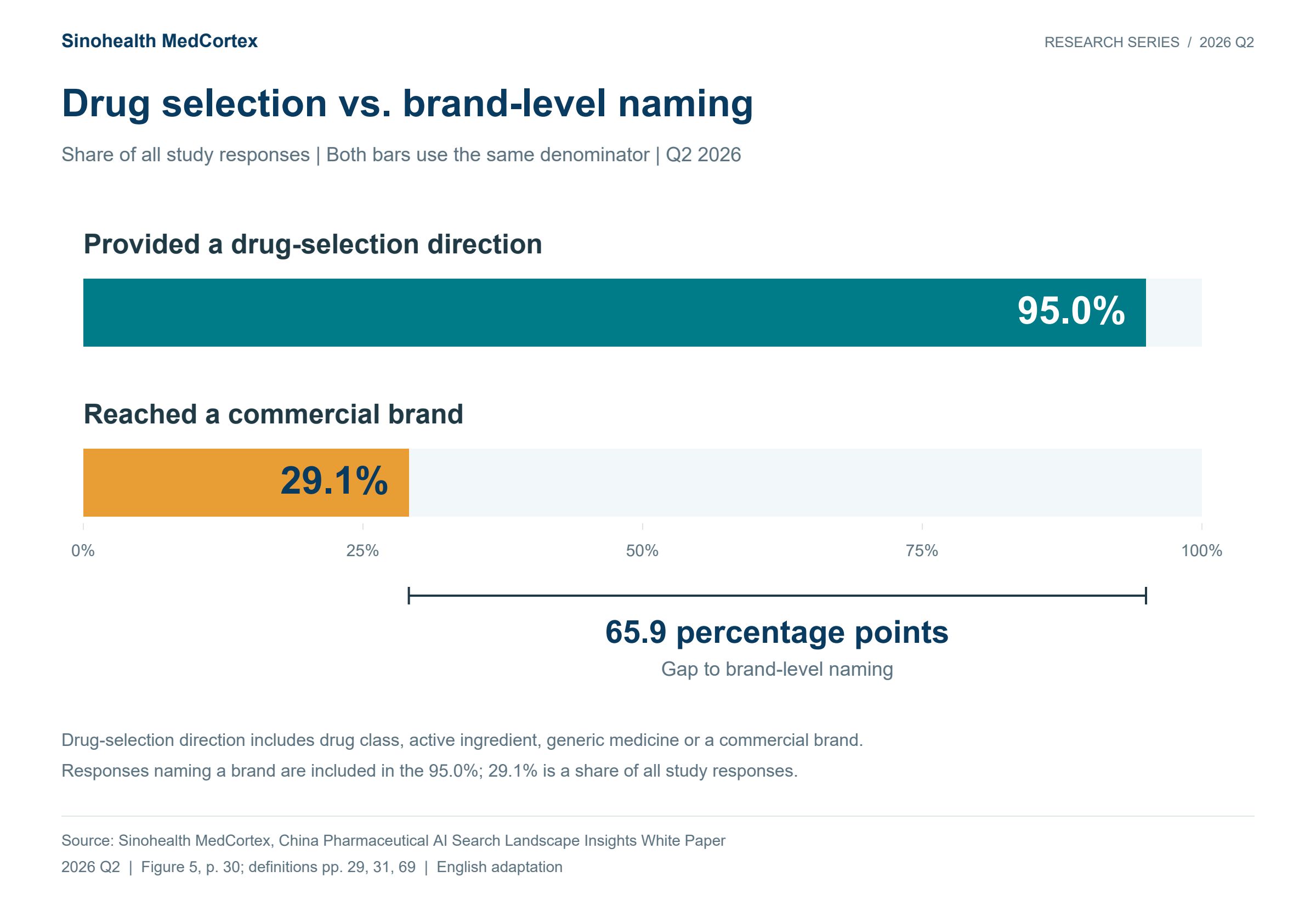
95.0% of responses provided at least one drug-selection direction. Only 29.1% reached a recognisable commercial brand. The gap was 65.9 percentage points.
This may be one of the most useful findings for pharmaceutical brands.
AI can correctly identify a therapeutic direction without having enough knowledge structure to connect that direction to a specific commercial product.
A coherent brand recommendation requires several relationships to hold at the same time:
health need → possible cause and risk → condition for action → drug class / ingredient / generic medicine → brand → usage boundaries
The white paper therefore treats brand placement as a cross-functional knowledge issue involving medical, regulatory, brand, patient-education and retail information.
This is where ontology becomes relevant
Pharmaceutical companies already possess large volumes of content.
The harder problem is connecting the underlying facts.
AI needs to understand relationships such as:
patient → symptom
symptom → possible disease
disease → risk
risk → appropriate action
condition → treatment
treatment → drug
drug → evidence
Each relationship also carries conditions.
Which population?
Which disease stage?
Under what circumstances?
What evidence supports the relationship?
When does it stop being valid?
This is essentially an ontology problem.
In practical terms, an ontology defines the entities in a domain, their relationships, and the conditions under which those relationships hold.
For pharmaceutical knowledge, that means organising patients, symptoms, diseases, risks, tests, treatments, drugs and evidence as a connected knowledge system.
This is also the direction we have been exploring in our broader knowledge-infrastructure work: moving from articles and pages toward objects, relationships, conditions and evidence.
The next layer is governance.
Medical knowledge needs:
provenance;
evidence;
version control;
ownership;
review cycles;
applicability boundaries.
The goal is a knowledge base that can be discovered, understood, verified and updated.
That becomes increasingly important when the same knowledge needs to support patients, healthcare professionals, search systems, RAG systems and future healthcare agents.
What this means for pharmaceutical AI strategy
1. Measure decision pathways
Brand visibility remains useful, but it should be connected to upstream variables: health need → pathway → medicine → brand → action.
2. Diagnose the point of failure
Low visibility can have several causes: the health need never entered a medication pathway; the AI interpreted the condition differently; the product lacked a clear contextual connection; or the answer stopped at the generic-drug level. These require different responses.
3. Structure knowledge around relationships
Product pages alone cannot carry the entire knowledge task. Companies need consistent relationships across disease education, medical evidence, prescribing information, patient education and retail communication.
4. Govern the knowledge lifecycle
AI systems operate on a changing information environment. Facts, evidence, safety boundaries and product information need clear sources, versions and update mechanisms.
A more useful definition of success
The research led us to a simple principle:
The right product should be available to AI when it is genuinely relevant, with the right conditions and boundaries attached.
The same principle works in reverse.
When the situation is unsuitable for self-medication, the knowledge system should support a safe transition to professional care.
This is why I increasingly see pharmaceutical AI search as part of a broader knowledge-governance problem.
AI is becoming another interface through which people interact with healthcare knowledge.
The quality of that interface will depend on how well the underlying medical world has been described, connected, governed and kept current.
In the next articles, I will look more closely at platform differences, category-specific decision structures, citation ecosystems and the design of AI-native pharmaceutical knowledge infrastructure.
About the research
The data discussed here comes from Sinohealth MedCortex's China Pharmaceutical AI Search Landscape Insights White Paper 2026 Q2.
The study covered five leading pharmaceutical categories in China's 2025 retail market, five major Chinese AI platforms and approximately 125,000 health-related queries. It focused on natural, non-brand-directed health needs at the top of the consumer decision funnel.
The findings describe the selected platforms, categories and AI environment during Q2 2026. Model updates, retrieval strategies and changes in the public information environment may alter future results. The study does not evaluate the clinical value of individual medicines.